23 Oct
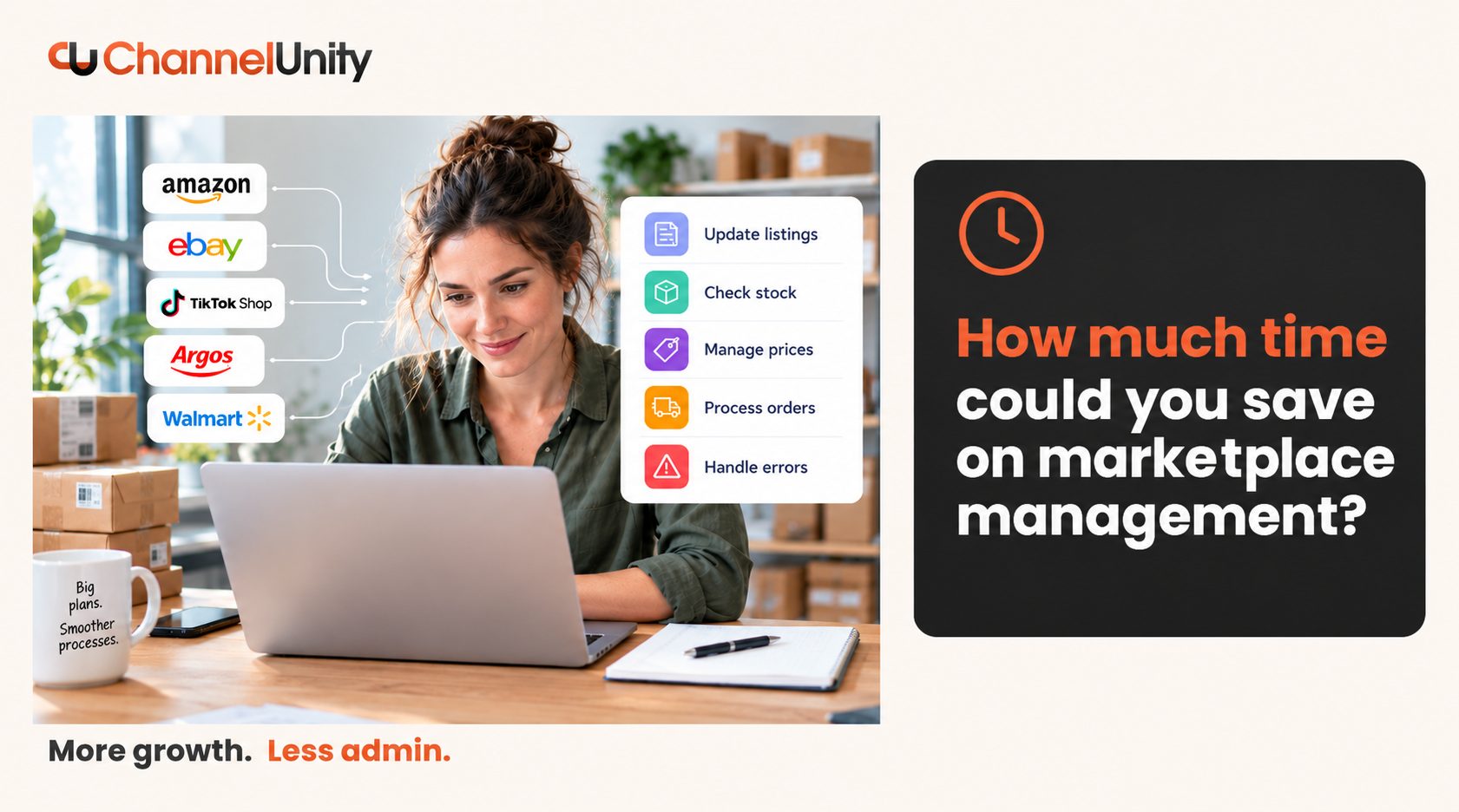
Selling on multiple marketplaces can help retailers reach new customers, increase sales and grow their businesses. But as the number of sales channels increases, so can the time and effort required to manage them.
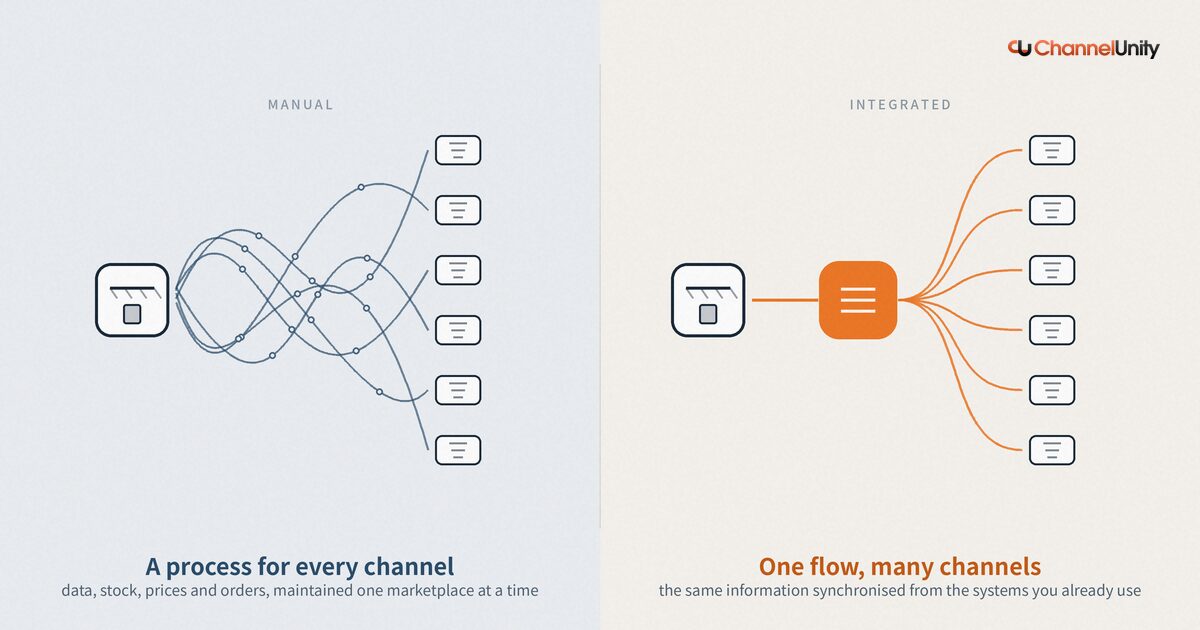
Product listings need maintaining. Stock levels must stay accurate. Prices change. Orders arrive from different channels, and tracking information needs to reach the right marketplaces.
When these tasks are handled manually, the workload can quickly add up.
The challenge is that much of this work doesn’t appear as a separate expense on a balance sheet. Instead, it is absorbed into employees’ working hours, leaving less time for activities that could help the business grow.
So, how much is manual marketplace management really costing your business?
1. The hidden cost of managing product listings
Every marketplace has its own requirements for product data, categories, attributes, images and variations. A listing that works on one channel may need adjustments before it can be published on another.
When managing a large catalogue across several marketplaces, these requirements can create a substantial administrative workload.
Your team might spend time:
- Creating and updating product listings across different channels.
- Adjusting product titles, descriptions and attributes.
- Mapping products to the correct marketplace categories.
- Updating images and product variations.
- Investigating listing errors and resolving rejected products.
The time required to maintain a handful of listings might be manageable. Multiply that workload across hundreds or thousands of products, however, and it becomes a different challenge.
There is also the ongoing maintenance to consider. When product information changes, those updates may need to be repeated across multiple marketplaces.
The hidden cost: time spent maintaining listings is time that could otherwise be invested in product development, merchandising or launching new sales channels.
2. Keeping stock levels accurate across every channel
Inventory management becomes more complicated when the same products are sold through several marketplaces.
Imagine selling a product through your own website, Amazon and eBay. If a customer purchases the last available unit on your website, the stock level needs to be reflected on your other sales channels as quickly as possible.
Without an effective synchronisation process, there is a risk that another customer could purchase an item that is no longer available.
This can result in cancelled orders, disappointed customers, additional customer service work and potential marketplace performance issues.
Manually checking and updating stock across multiple channels creates another recurring task for your team. It also introduces opportunities for mistakes, particularly during busy trading periods.
Automated stock synchronisation can help keep inventory information aligned across connected sales channels, reducing the need for repeated manual updates.
3. Processing orders from multiple marketplaces
Order management is another area where manual processes can become increasingly time-consuming.
Depending on how your business operates, your team might need to log into individual marketplaces, check for new orders, transfer order details into another system and update each marketplace when orders are dispatched.
Each step might seem relatively straightforward on its own. The difficulty comes from repeating the process across multiple channels, day after day.
As order volumes increase, the workload can increase alongside them.
Connecting marketplaces to your ecommerce platform or order management system can help automate the movement of order information between systems. This reduces the need to manage every marketplace as a separate workflow.
It can also help your team maintain a more consistent process for handling orders, fulfilment and shipment updates.
4. The cost of updating prices and product information
Product information rarely stays the same forever.
Prices change in response to costs, promotions and trading decisions. Product descriptions are improved, images are replaced and new products are introduced.
When the same products are listed across multiple marketplaces, these changes need to reach the relevant channels.
If updates are made manually, your team must remember which marketplaces need changing and ensure that each update is completed correctly.
An outdated price or inconsistent product detail can create confusion for customers and additional work for your team.
Automating price and product data updates, where supported by the relevant integrations and marketplace requirements, can reduce repetitive administration and help maintain consistency across sales channels.
5. The additional workload of expanding into new marketplaces
Adding another marketplace creates an opportunity to reach a new audience. However, it can also introduce another set of processes, data requirements and operational responsibilities.
Before launching a new channel, retailers may need to consider:
- Product data and category requirements.
- Listing configuration and marketplace-specific attributes.
- Stock and pricing synchronisation.
- Order imports and fulfilment workflows.
- Shipping confirmations and tracking updates.
- Ongoing monitoring and error handling.
If each new marketplace requires a separate manual process, expansion can become increasingly difficult to manage.
This is why it is worth considering your operational setup before adding more channels. The right integration approach can help you manage additional marketplaces without having to recreate every process from scratch.
6. The opportunity cost of manual work
The cost of manual marketplace management isn’t limited to the tasks themselves. It also includes the work your team could be doing instead.
Time spent copying product information, reconciling stock or transferring orders is time unavailable for other activities.
For example, your team could be focusing on:
- Identifying new marketplace opportunities.
- Improving product listings and conversion rates.
- Analysing sales performance.
- Developing promotional campaigns.
- Improving customer service.
- Expanding into new territories.
These activities can contribute to business growth, but they are harder to prioritise when routine administration takes up a significant proportion of the working week.
Reducing repetitive tasks can give your team more capacity to focus on activities that require commercial judgement, creativity and decision-making.
7. Calculate the cost of your manual marketplace processes
One way to understand the impact is to estimate how much time your team spends on manual marketplace administration.
Consider this illustrative example.
A retailer spends 16 hours per week on tasks such as updating listings, checking stock, managing prices and transferring orders between systems.
If the estimated employment cost is £18 per hour, the calculation looks like this:
| Calculation | Cost |
|---|---|
| Weekly time spent | 16 hours |
| Estimated cost per hour | £18 |
| Weekly cost | £288 |
| Average monthly cost | £1,248 |
| Annual cost | £14,976 |
Figures are illustrative estimates, using 52 weeks divided by 12 to calculate the average month. The hourly rate represents an assumed employment cost, not a market benchmark.
That’s the equivalent of two full working days every week spent on manual marketplace administration, adding up to almost £15,000 in estimated annual employment costs.
To calculate your own figure, consider the time spent on each recurring task across all marketplaces. Include time spent investigating errors and correcting mistakes, not just routine updates.
If several employees are involved, calculate the cost for each person and add the totals together.
This figure isn’t necessarily an amount that could be saved in full through automation. Some tasks will still require human involvement, and the cost of implementing and operating an integration must also be considered.
However, it gives you a useful starting point for identifying where improvements could make a difference.
8. When should you consider marketplace automation?
Manual processes aren’t necessarily a problem when you are selling through a small number of channels with a manageable product range.
The challenge is recognising when your existing approach is becoming a barrier to growth.
You may benefit from reviewing your processes if:
- Your team spends several hours each week updating the same information across different marketplaces.
- Stock discrepancies regularly require investigation.
- Order volumes are increasing, but your processes remain largely manual.
- Launching a new marketplace involves significant additional administration.
- Product updates take longer than expected to reach every channel.
- Spreadsheets and manual checks have become essential to keeping your operation running.
- Your team has limited time for activities beyond day-to-day marketplace management.
These signs don’t automatically mean every process needs to be automated. Instead, they provide an opportunity to assess where integration could reduce repetitive work, improve consistency and support future growth.
How ChannelUnity can help reduce manual marketplace management
ChannelUnity connects ecommerce platforms and business systems with online marketplaces, helping retailers manage key data flows through an integrated multichannel operation.
Depending on the connected platforms and marketplace capabilities, this can include product data, stock levels, prices, orders and shipment tracking.
Rather than manually updating each sales channel in isolation, retailers can automate supported processes between their existing systems and connected marketplaces.
This can help reduce repetitive administration, improve the consistency of information across channels and make it easier to manage a growing marketplace operation.
For businesses looking to expand, integration can also provide a more structured way to introduce additional sales channels without unnecessarily increasing the manual workload.
The best starting point is to understand how your current processes work, where your team spends the most time and which tasks would benefit most from automation.
Build a more scalable multichannel operation
Selling across multiple marketplaces creates opportunities, but managing those channels manually can introduce costs that are easy to overlook.
The time spent maintaining listings, updating stock, processing orders and managing prices can accumulate into a significant operational commitment. As your business grows, that commitment can become increasingly difficult to sustain.
Understanding the cost of these processes is the first step towards improving them.
By identifying repetitive tasks and exploring where automation could help, retailers can make more informed decisions about their technology and build an operation that is better equipped to support growth.
Want to spend less time managing marketplaces manually?
Find out how ChannelUnity can help connect your ecommerce platform with your marketplaces and automate key multichannel processes.
Contact ChannelUnity to discuss your integration requirements.