17 Sep
The Hidden Costs of Selling on Multiple Marketplaces – And How to Reduce Them
Selling on multiple marketplaces can be a powerful way for retailers and brands to reach new customers, increase sales and expand into new markets.
But while the potential revenue is easy to see, the operational cost of managing multiple sales channels is often less obvious.
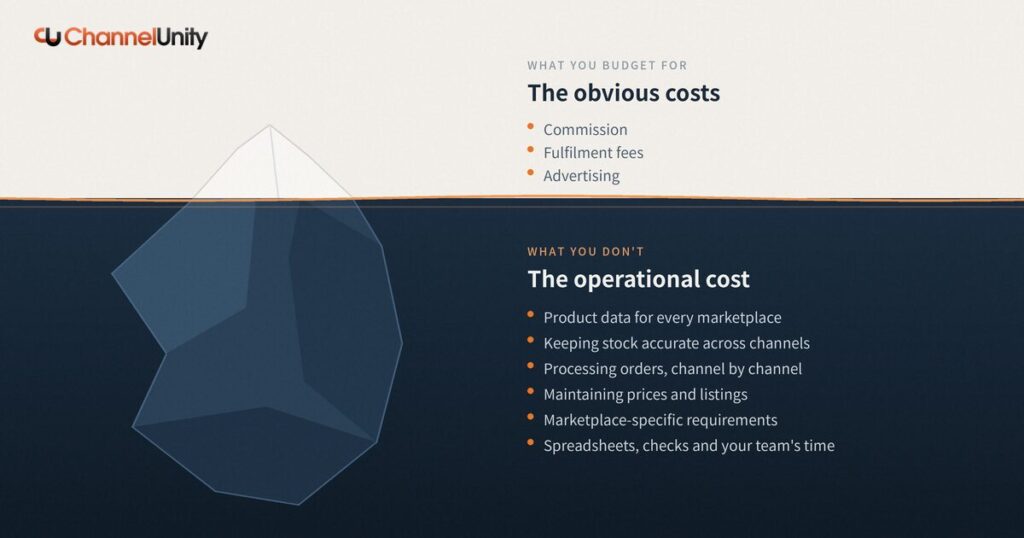
Marketplace commissions, fulfilment fees and advertising costs are usually built into the business case. What can be harder to calculate is the time and resource required to keep product data, stock, prices, orders and listings up to date across every channel.
As the number of marketplaces increases, so can the administrative workload.
The good news is that this doesn’t necessarily have to happen at the same rate as your marketplace growth. With the right processes and automation in place, businesses can expand across multiple marketplaces without creating an equivalent increase in manual work.
The obvious costs of selling on marketplaces
Before looking at the hidden costs, there are the more obvious expenses associated with selling through marketplaces.
Depending on the channel, these can include:
- Marketplace commission
- Listing or subscription fees
- Fulfilment and delivery charges
- Payment processing fees
- Advertising and promotional costs
- Returns and refunds
- Currency conversion costs when selling internationally
These costs are relatively straightforward to identify when calculating marketplace profitability.
The less obvious costs are often found in the day-to-day work required to operate each channel.
1. The cost of managing product data
One of the biggest challenges of selling on multiple marketplaces is that there is rarely a single approach to product data.
Each marketplace can have its own:
- Categories and taxonomy
- Required attributes
- Product specifications
- Title and description requirements
- Image requirements
- Variation structures
- Data formats
A product that is ready to sell on one marketplace may need additional information or restructuring before it can be listed on another.
For a small catalogue, making these changes manually might seem manageable. But when a retailer has hundreds or thousands of products, the workload can quickly become significant.
Every new marketplace potentially creates another set of product data requirements to maintain.
2. The cost of keeping stock accurate
Stock accuracy becomes increasingly important as more sales channels are added.
Imagine a retailer selling the same product through its own website, Amazon, eBay and several other marketplaces. If stock isn’t updated quickly across every channel, one sale can affect the availability of that product everywhere else.
This can create problems such as:
- Overselling
- Cancelled orders
- Manual stock adjustments
- Customer-service queries
- Marketplace performance issues
- Time spent reconciling stock discrepancies
Keeping stock synchronised across channels can therefore be much more than an operational convenience. It can help retailers maintain a consistent view of inventory wherever they sell.
3. The cost of processing orders
Processing marketplace orders manually may not seem particularly expensive when you’re selling through one channel.
The problem comes with scale.
A team might need to log into multiple marketplaces, check for new orders, enter or import those orders into their ecommerce or fulfilment system, update order statuses and send tracking information back to each marketplace.
Repeat that process across several channels, every working day, and the hours quickly add up.
The more successful a marketplace strategy becomes, the more orders there are to process.
Without automation, increased sales can therefore bring increased administration with them.
4. The cost of maintaining prices and listings
Marketplace listings aren’t something that can simply be created once and forgotten about.
Prices change. Products are discontinued. New products are launched. Descriptions are updated. Images change. Promotions are introduced. Stock availability fluctuates.
When products are listed across multiple marketplaces, every change potentially needs to be reflected across multiple channels.
This creates another hidden cost: the time spent making sure that information is consistent.
A manual approach can also increase the risk of information becoming outdated on one marketplace while remaining correct elsewhere.
5. The cost of managing marketplace-specific requirements
Every marketplace has its own way of doing things.
Even when two marketplaces appear to offer similar functionality, the underlying requirements and processes can be very different.
One marketplace might use a particular product taxonomy. Another might require different attributes. Variation handling can differ between channels, while order, fulfilment and tracking processes can also vary.
This means that expanding into another marketplace isn’t always as simple as copying existing listings across.
The more channels a retailer operates, the more marketplace-specific knowledge the team may need to maintain.
6. The cost of spreadsheets and manual processes
Spreadsheets can be incredibly useful, particularly when a business is starting out.
But as the number of products, orders and marketplaces increases, they can become a sign that the operation has outgrown its original processes.
Teams may find themselves using spreadsheets to track:
- Product information
- Marketplace listings
- Stock levels
- Prices
- Orders
- Errors and exceptions
- Marketplace requirements
The spreadsheet itself isn’t necessarily the problem. The problem is the amount of manual work required to keep everything in it accurate.
Every manual process introduces another opportunity for something to be missed, duplicated or entered incorrectly.
7. The opportunity cost
Perhaps the biggest hidden cost isn’t a marketplace fee at all.
It’s the time your team spends managing tasks that could potentially be automated.
An employee spending several hours every week updating marketplace listings, reconciling stock or processing orders is spending less time on other activities.
That could mean less time available for:
- New product launches
- Merchandising
- Customer relationships
- Sales and marketing
- Marketplace expansion
- International growth
- Improving the customer experience
This is where the real cost of manual marketplace management can become difficult to measure.
The question isn’t simply:
“How much does it cost us to manage our marketplaces?”
It can also be:
“What could our team be doing instead?”
Does adding another marketplace have to mean adding more work?
Not necessarily.
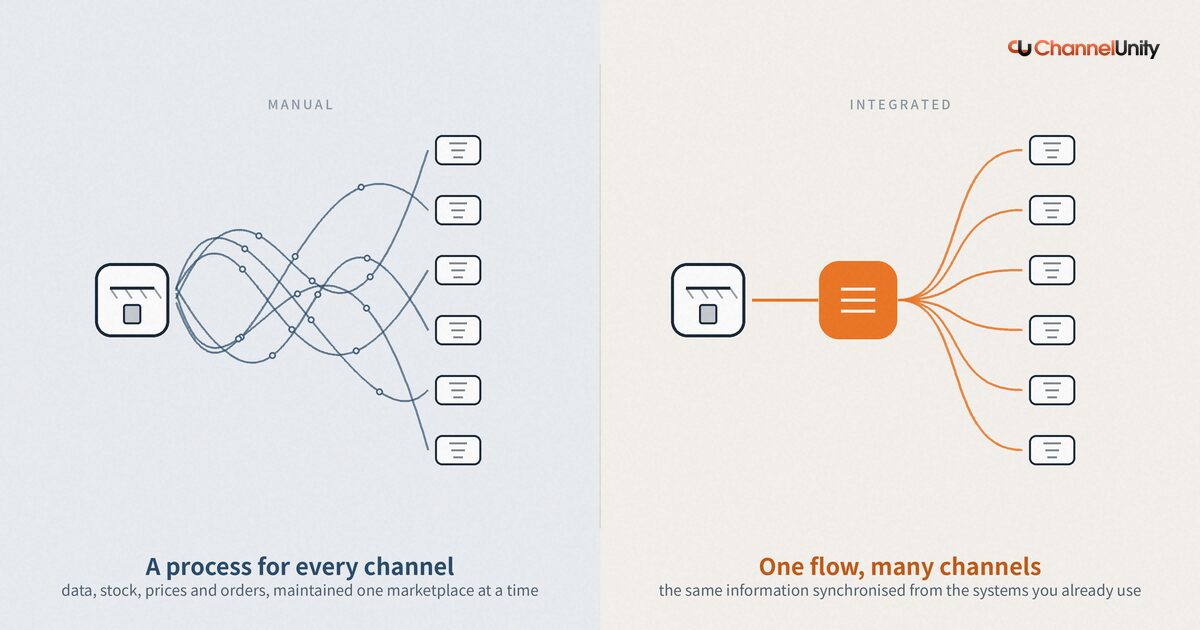
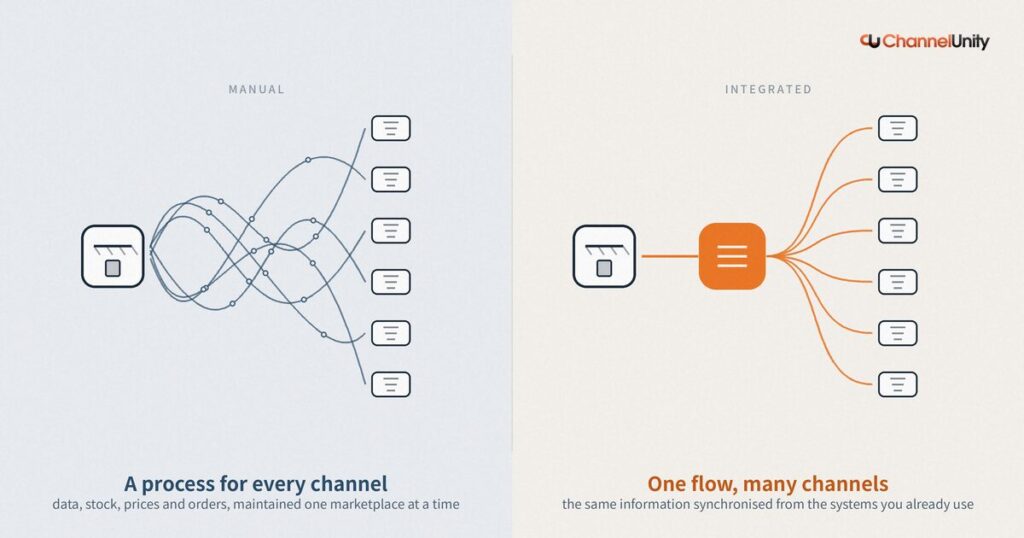
A successful multichannel strategy doesn’t have to mean managing every marketplace individually.
Marketplace automation and integration can connect marketplaces with your ecommerce platform or back-office systems, helping you manage multiple sales channels from the systems you already use.
Instead of manually maintaining each channel, key information can be synchronised between systems.
For example:
Product data → Marketplaces
Product information can be distributed to the relevant sales channels, with marketplace-specific requirements managed as part of the process.
Stock → Marketplaces
Available stock can be synchronised across channels to help maintain accurate inventory levels.
Prices → Marketplaces
Price changes can be distributed without requiring teams to update every marketplace individually.
Orders → Ecommerce platform
Orders from multiple marketplaces can be brought back into the retailer’s existing workflow.
Tracking → Marketplaces
Shipping and tracking information can be sent back to the relevant marketplace once an order has been fulfilled.
The result is that adding another sales channel doesn’t necessarily have to mean adding another completely separate process.
The real cost of marketplace expansion
Selling on more marketplaces can create significant opportunities, but the operational side of multichannel ecommerce shouldn’t be overlooked.
The true cost isn’t just what each marketplace charges you.
It’s also the time required to manage product data, stock, prices, listings and orders across every channel.
For retailers considering marketplace expansion, understanding these operational costs early can help them decide which processes need to be automated before they scale.
The goal isn’t simply to sell on more marketplaces.
It’s to build an operation that can support more marketplaces without creating an ever-growing administrative workload.
How ChannelUnity can help
ChannelUnity connects ecommerce platforms & ERPs with marketplaces, helping retailers manage product data, stock, prices, orders and tracking from a centralised platform.
By automating the flow of information between systems, ChannelUnity can help businesses reduce manual marketplace administration and build a more scalable multichannel operation.
Contact us today to find out more about ChannelUnity’s marketplace integrations.