27 Aug

For ecommerce businesses looking beyond their domestic market, international expansion can open the door to significant new opportunities.
But entering a new market isn’t simply a case of putting products in front of a new audience. Merchants need to consider everything from product data and pricing to inventory, orders and fulfilment. And when that new market comes with its own established marketplace ecosystem, managing another sales channel can quickly add complexity.
For retailers looking to expand into the Netherlands and Belgium, bol offers an established route into one of Europe’s most digitally mature ecommerce markets.
And with the right marketplace integration in place, adding bol doesn’t have to mean adding another disconnected system to your operation.
What is bol?
Bol is one of the leading online marketplaces in the Netherlands and Belgium.
Originally launched in 1999, the platform has grown into a major part of the region’s ecommerce landscape. As of 31 March 2026, bol reported 14 million active customers, 26 million active users per month, 63 million products and 43,300 sales partners across the Netherlands and Belgium.
That scale makes bol an interesting opportunity for merchants looking to reach customers in the Benelux without having to build an entirely new customer base from scratch.
For international sellers, bol also provides access to an established marketplace infrastructure, including fulfilment and logistics services, advertising tools and support for international partners.
Why are merchants looking to the Benelux?
International expansion has become an increasingly important part of the growth strategy for ecommerce businesses.
For UK retailers in particular, the Benelux can offer an attractive opportunity. Bol’s own research highlights the region’s high levels of ecommerce adoption, strong purchasing power and digitally engaged consumers. It also points to the important role marketplaces play in the Dutch and Belgian customer journey.
The Netherlands and Belgium may be smaller markets than some of Europe’s largest economies, but their ecommerce maturity makes them particularly interesting for retailers looking to expand.
And bol sits at the centre of that opportunity.
For British brands, bol describes itself as a route to millions of customers across the Netherlands and Belgium, while also providing access to an established marketplace ecosystem and international partner support.
The challenge of adding another marketplace
Of course, reaching new customers is only one part of the equation.
Once a merchant starts selling on another marketplace, they need to keep their wider ecommerce operation connected.
Product information needs to be accurate.
Stock levels need to stay up to date.
Prices need to reflect the latest changes.
Orders need to reach the systems responsible for fulfilment.
Shipping and tracking information needs to make its way back to the marketplace.
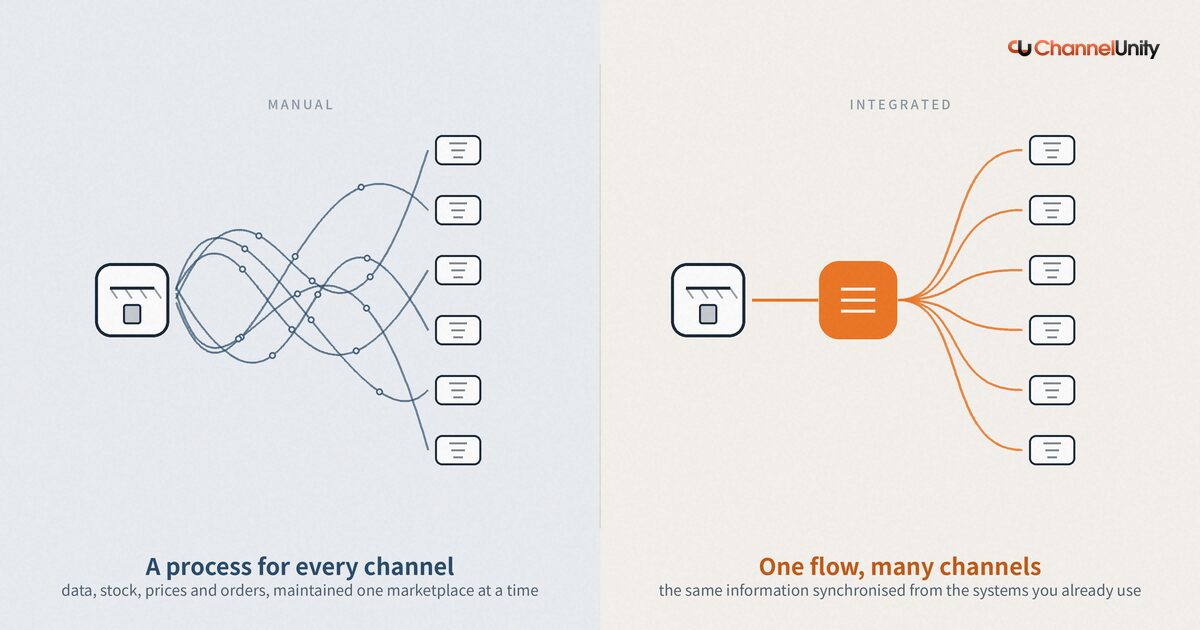
Managing each of these processes manually can quickly become time-consuming, particularly for merchants already selling across several channels.
That’s why connecting bol to the systems a business already uses can make such a difference.
Selling on bol with ChannelUnity
ChannelUnity’s new bol integration allows merchants to bring the marketplace into their existing multichannel ecommerce operation.
Whether you’re starting to sell on bol or already have listings on the marketplace, ChannelUnity can help connect the channel to the rest of your ecommerce infrastructure.
Create new bol listings
For merchants expanding onto bol for the first time, ChannelUnity can be used to create new listings.
This means bol can become part of the same marketplace strategy as the merchant’s other sales channels, rather than requiring a completely separate product management process.
Connect existing bol listings
Already selling on bol?
You don’t necessarily need to start again.
ChannelUnity can connect existing bol listings, allowing merchants to bring an established bol catalogue into their wider marketplace setup.
This is particularly useful for businesses that already have products, listings and sales history on bol but want to centralise their marketplace management.
Keep stock synchronised
Selling the same products across multiple channels creates an obvious challenge: keeping inventory accurate.
ChannelUnity synchronises stock with bol, helping merchants maintain consistent availability across their sales channels.
That means when inventory changes in the merchant’s ecommerce system, the relevant stock information can be passed through to bol rather than relying on someone to update it manually.
Keep pricing up to date
Pricing is another area where manual marketplace management can quickly become difficult.
ChannelUnity synchronises pricing with bol, allowing merchants to manage their pricing as part of their wider multichannel operation.
Instead of treating bol as an isolated channel, merchants can incorporate it into the same processes they use across their other marketplaces.
Bring bol orders into the existing workflow
Selling more products is great. Managing the resulting orders is another matter.
ChannelUnity can import bol orders into the merchant’s existing ecommerce workflow, helping ensure that orders from the marketplace can be processed alongside orders from other sales channels.
This removes another layer of manual administration and gives merchants a more connected view of their orders.
Send shipping and tracking information back to bol
The order journey doesn’t end when an order is received.
Once an order has been fulfilled, shipping and tracking information can be sent back to bol through ChannelUnity.
This keeps the marketplace and the merchant’s fulfilment operation connected throughout the order lifecycle.
Already selling on bol? You don’t have to start again
One of the key benefits of the integration is the ability to connect existing bol listings.
For merchants that have already invested time in building their presence on bol, moving to a more centralised marketplace management approach shouldn’t mean rebuilding their catalogue from scratch.
Instead, existing listings can be connected to the merchant’s wider ChannelUnity setup, allowing bol to become another integrated sales channel alongside their other marketplaces.
New to bol? Build it into your multichannel strategy from the start
For merchants yet to sell on bol, integrating the marketplace into their existing ecommerce operation from the outset can help avoid creating another standalone workflow.
New listings can be created, while stock, pricing, orders and shipping information can be managed through the connected ChannelUnity setup.
This is particularly valuable for businesses that already understand the benefits of marketplace automation and want to expand their reach without expanding their administrative workload at the same rate.
Expanding into the Benelux doesn’t have to mean doubling your workload
International expansion inevitably introduces new considerations.
Merchants need to understand marketplace requirements, customer expectations, tax and VAT considerations, delivery requirements and local market differences. Bol itself highlights the importance of areas such as local content, shipping and VAT when selling across the Netherlands and Belgium.
Technology can’t remove all of those considerations.
But it can remove a significant amount of the repetitive work involved in managing another marketplace.
By connecting bol with the systems already used to manage products, inventory, orders and fulfilment, merchants can make the marketplace part of their existing operation rather than creating another one alongside it.
Make bol part of your wider marketplace strategy
For ecommerce businesses looking to expand into the Netherlands and Belgium, bol presents an opportunity to reach a substantial and established customer base.
But successful marketplace expansion isn’t just about getting listed.
It’s about being able to manage the channel efficiently as sales grow.
With ChannelUnity, merchants can create new bol listings, connect existing listings, synchronise stock and pricing, import orders and send shipping information back to the marketplace.
That means bol can sit alongside the rest of your marketplace estate, connected to the systems and processes you already rely on.
Looking to expand into the Benelux?
ChannelUnity’s new bol integration makes it easier to connect your ecommerce operation with one of the Netherlands and Belgium’s leading marketplaces — helping you reach new customers without creating another disconnected sales channel to manage.