13 Aug

Marketplace integration has come a long way.
For many ecommerce businesses, the basics are now well established: products are published to marketplaces, inventory is synchronised, prices are updated and orders flow back into the systems responsible for fulfilment.
But there is another part of the marketplace journey that is often overlooked.
The money.
An order arriving in an ERP or ecommerce platform tells a business that a sale has happened. It doesn’t necessarily tell the full financial story of that sale.
Marketplace fees, refunds, adjustments, payments and other financial transactions all contribute to the amount a business ultimately receives. If that information remains isolated within the marketplace, the integration is only telling part of the story.
For businesses selling significant volumes through marketplaces, that gap can become increasingly difficult to manage.
From orders to financial reality
When businesses think about marketplace integration, the conversation usually starts with operational data.
Products need to be listed.
Stock needs to be updated.
Prices need to change.
Orders need to be imported.
Shipping information needs to flow back.
These are all essential. But once the sales start happening at scale, another question becomes just as important:
What happened financially?
A £100 sale on Amazon isn’t necessarily a £100 payment to the merchant.
The financial position can be affected by marketplace fees, refunds, adjustments and other transactions. Amazon’s Selling Partner API (SP-API) provides access to financial information relevant to a seller’s business, including transactions and financial events. The current Finances API can retrieve transactions by date and marketplace, while Amazon’s financial-event operations can be used to understand the events associated with payments and financial event groups.
That information has real value outside Amazon.
The challenge is getting it there.
The financial data gap
For a growing marketplace seller, financial reconciliation can quickly become a manual exercise.
A finance team might have one set of information in an ERP, another in Amazon Seller Central and additional spreadsheets or reports used to reconcile the two.
That creates a familiar problem: the marketplace becomes another financial data silo.
The more marketplaces a business operates across, the more complicated that becomes.
And this isn’t simply about saving someone from downloading a spreadsheet.
Disconnected financial information can make it harder to:
- Reconcile marketplace sales and payments
- Understand the true cost of selling through a marketplace
- Identify fees and adjustments
- Match marketplace activity with accounting records
- Build a consolidated view of trading performance
- Scale marketplace operations without increasing manual administration
The operational side of ecommerce may be automated, while the financial side is still being managed manually.
That’s a strange place for a modern omnichannel business to be.
Closing the financial data gap
This is where marketplace integration needs to go beyond the traditional order flow.
ChannelUnity can use Amazon’s financial APIs to retrieve relevant financial information and make that data available to the systems a business relies on to manage its operations and finances.
For example, we currently support the flow of specific Amazon financial information into SAP and Netsuite. The same approach can be used to connect marketplace financial data with other ERPs, ecommerce platforms, accounting systems or business applications.
The important part is the connection between the marketplace and the wider business.
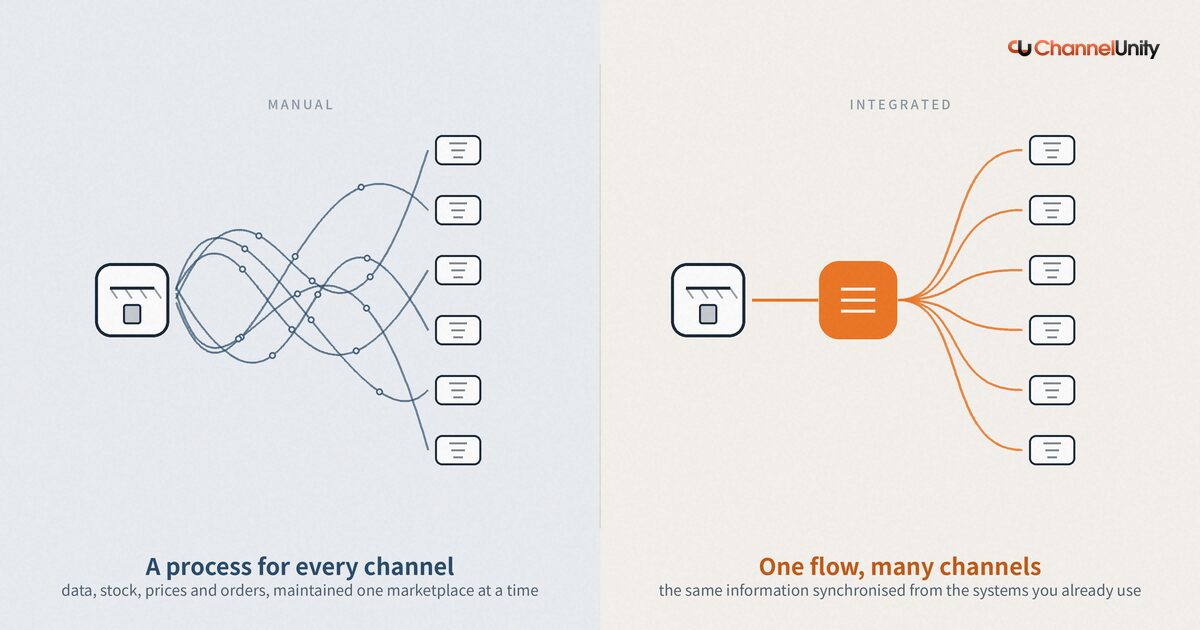
Rather than leaving financial information within Amazon or relying on manual exports and reconciliation, businesses can bring that data into the systems where it can be processed, reported on and reconciled alongside the rest of their commercial information.
This turns marketplace finance from a separate process into part of the wider integration architecture.
And as marketplace sales grow, that distinction becomes increasingly important.
Contact us today and take your business to the next level.